

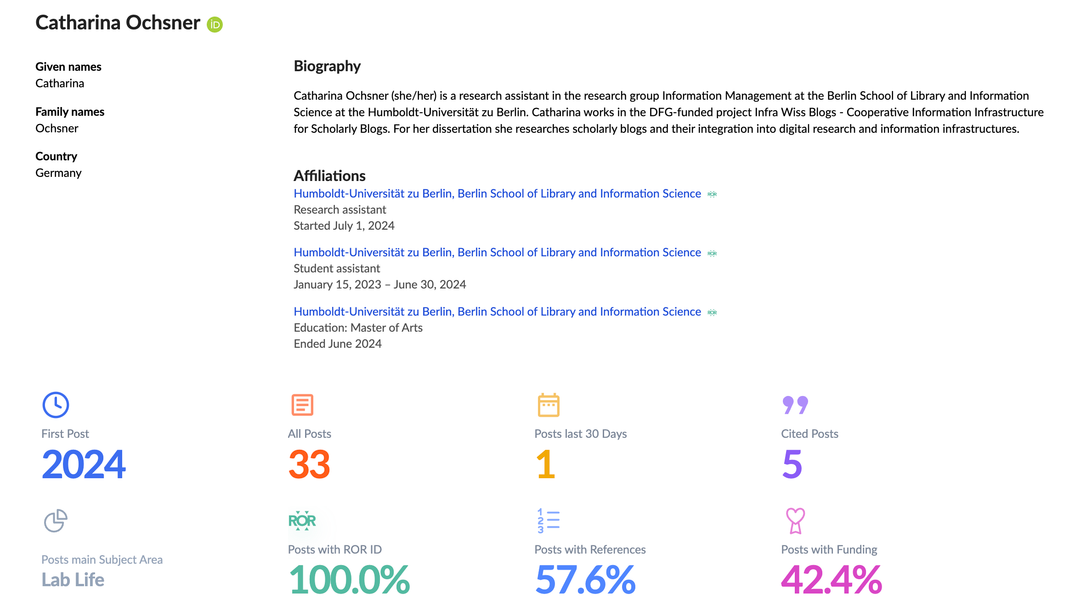
This week the Rogue Scholar author profiles that were launched in June were improved in several important ways. Author profiles are now generated fully automated from the pubic ORCID profile and therefore automatically available for all authors with an ORCID, and affiliation profile pages are now also available.
The ORCID annual public data file (last released October 2025) contains 25,048,059 public ORCID profiles that can be imported in bulk, making them immediately available for Rogue Scholar author profiles. The profiles in ORCID XML format are converted to commonmeta JSON format, which supports person information in the new schema 1.0. Commonmeta-py is already included in Rogue Scholar for other reasons, and can also be used to handle ORCID profile information.
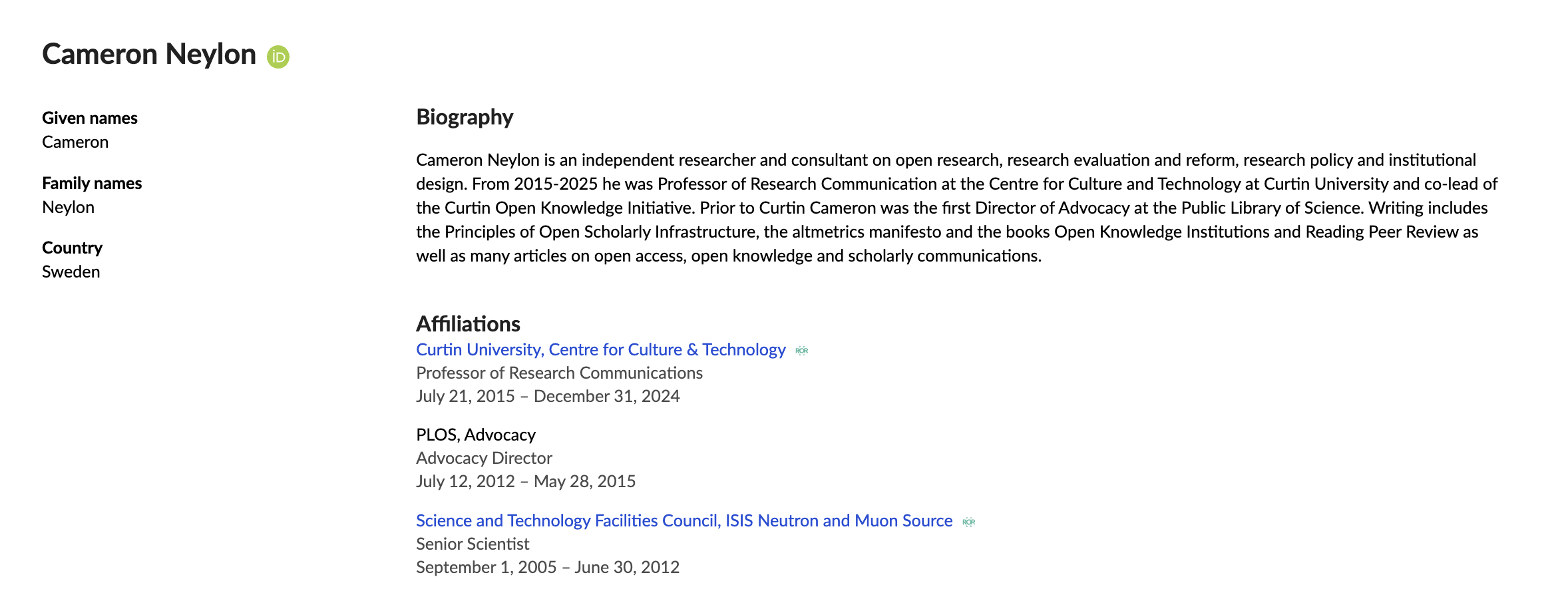
While this fully-automated workflow enables potentially thousands of author profiles in Rogue Scholar, there are some important limitations:
- ORCID profiles may have been updated since October 2025, so profiles need to be updated with a single built-in API call to be current,
- Biographies are not included in the summaries available in the annual data file, so again need to be fetched with the same single built-in API call, and
- while ORCID is supporting ROR organizational identifiers, many ORCID profiles still use Ringgold identifiers and haven't been updated. Another built-in API call is needed for the Ringgold -> ROR mapping using the Wikidata SPARQL query service.
Author profiles not only summarize all blog posts by a single author (potentially across several blogs), but they are important for Rogue Scholar metadata quality for two reasons:
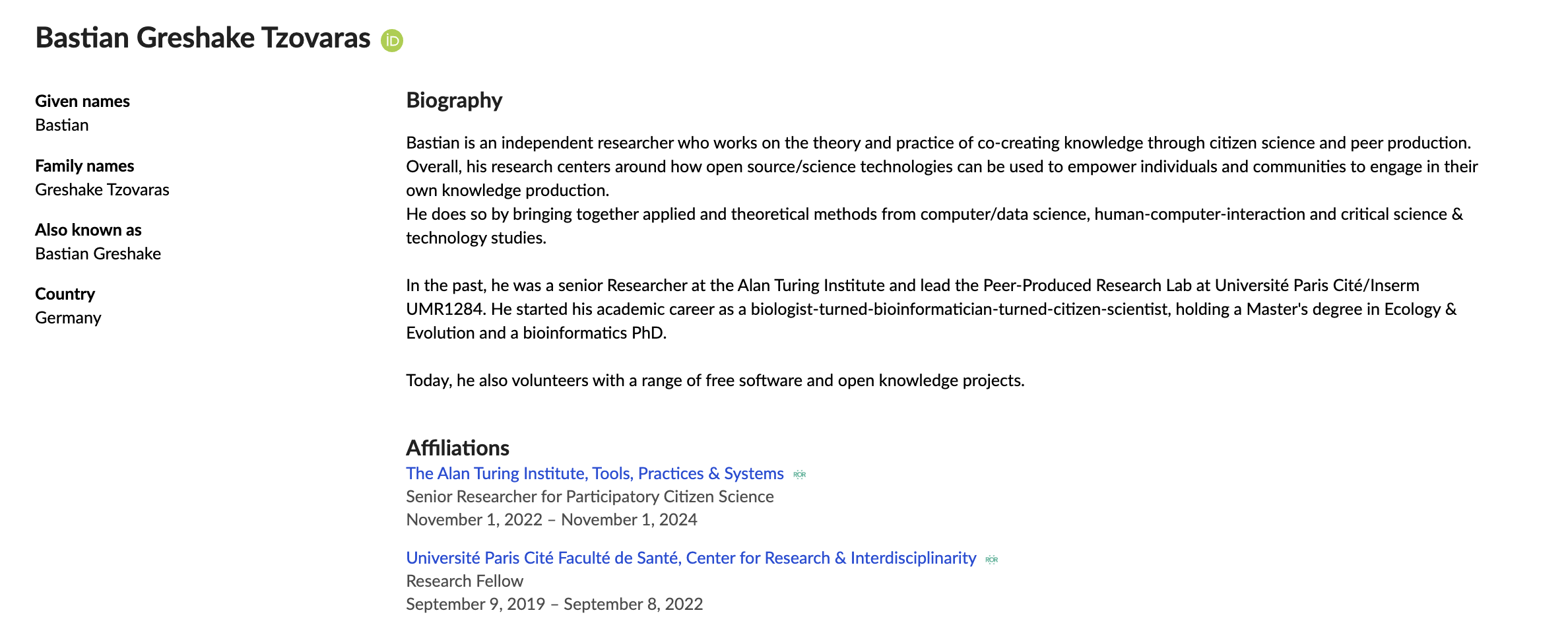
- blogging software treats author names as single strings and doesn't know about given or family names, which becomes an issue when an author has multiple given and/or family names. ORCID profiles contain public information about given and family names, as well as name variants.
- for associating a blog post with an organization, we need to know the start and end date of an author's institutional affiliation. There are issues with multiple parallel affiliations, but for the majority of Rogue Scholar blog post authors, this information can be found in the ORCID public profile.
You can see both issues handled in this profile:
Since Rogue Scholar already wants to know about author affiliations to show them with each blog post, it is only a small step to show all blog posts from an institution via an institutional profile page.
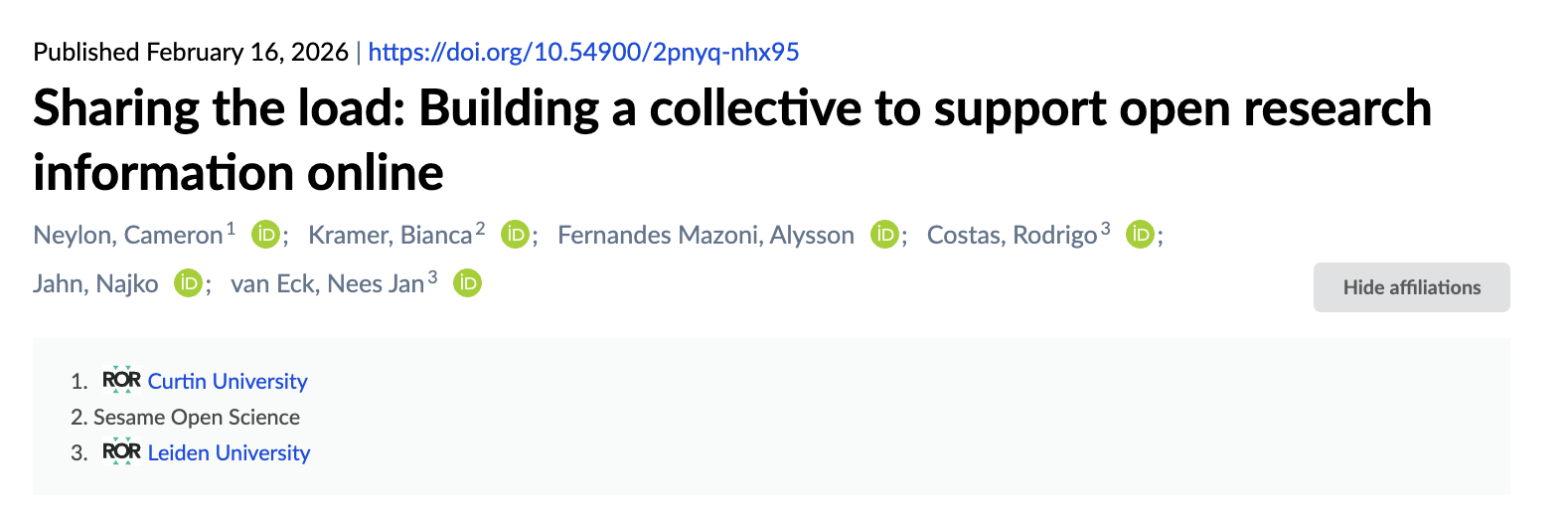
Starting this week, the affiliations are linked to an institutional profile page from every blog post, just as every author with an ORCID is linked to his author page, for example Leiden University from the example above:
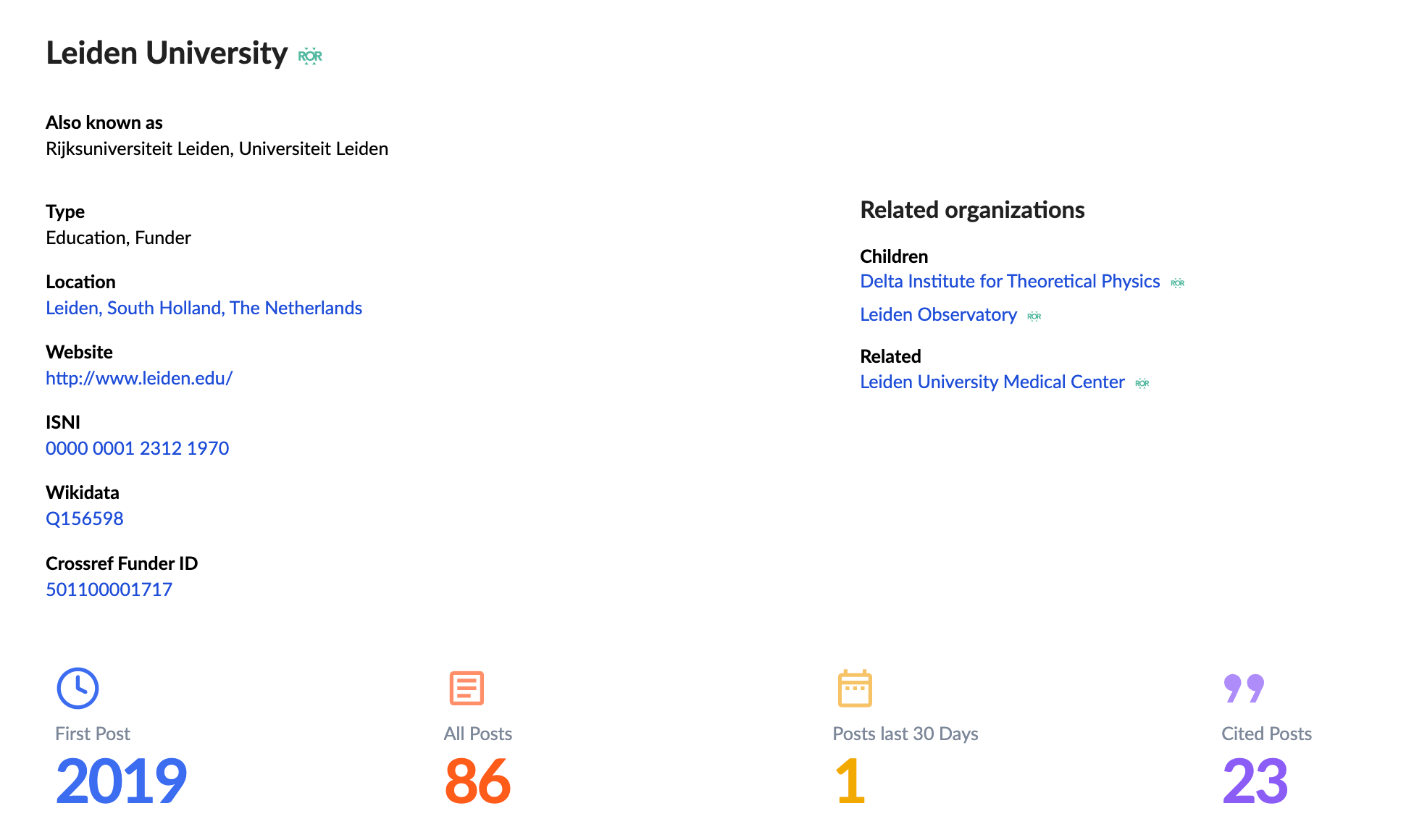
The InvenioRDM platform that powers the Rogue Scholar backend already imports the ROR vocabulary with more than 100,000 institutions. Unfortunately that doesn't include all the information shown on the institutional profile page, which basically shows the same information as the ROR registry (see above). This again is handled by commonmeta-py and the commonmeta JSON schema, which in version 1.0 describes works, people and organizations.
More work is needed to more deeply integrate the author and institution profiles with the rest of the Rogue Scholar platform, e.g. to be able to search all 25 million ORCID records in the record submission form, but the changes announced today already greatly improve the visibility of science blog posts, if the author wants that. There are of course good reasons to use your ORCID or institutional affiliation when publishing a blog post, and Rogue Scholar respects that.
Please reach out via Slack, email, Mastodon, or Bluesky if you have any questions or comments.
References
- Fenner, M. (2026, June 15). Rogue Scholar launched author profiles this week. Front Matter. https://doi.org/10.53731/204cn-q6m42
- ORCID. (2025). ORCID Annual Public Data Files. ORCID. https://doi.org/10.23640/07243.C.7931102
- Fenner, M. (2026, July 15). Announcing the commonmeta schema 1.0 release candidate. Front Matter. https://doi.org/10.53731/kdqkf-nf052
- Fenner, M. (2025, May 6). Personal names in science blogs. Front Matter. https://doi.org/10.53731/r5fw0-tdd11
