

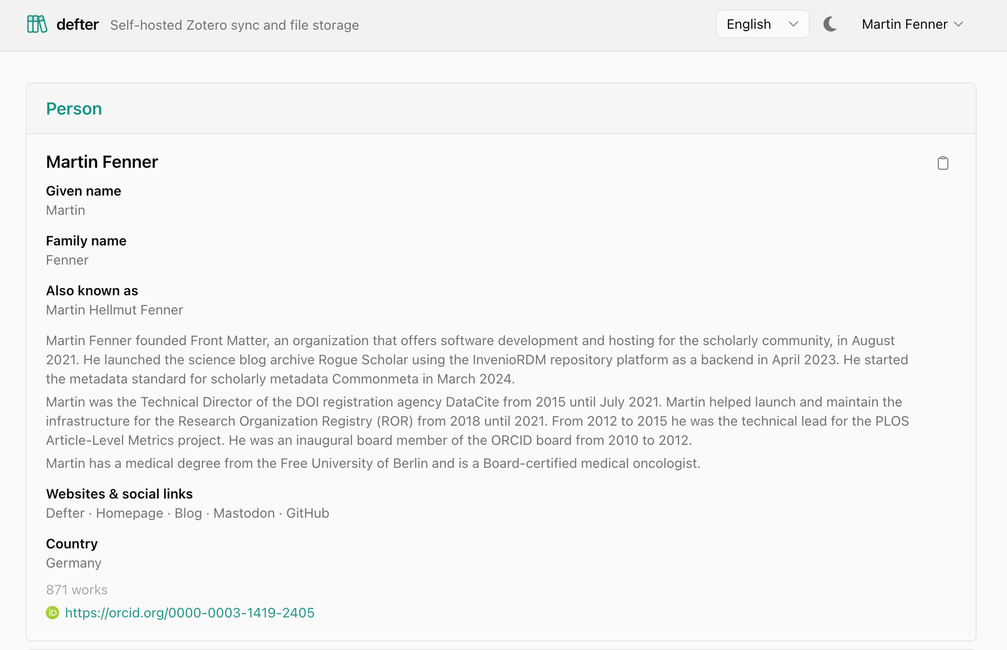
Today I am announcing defter, a new Zotero sync and file storage server that complements Zotero Storage with a hosted Zotero library using SQLite and S3-compatible object storage.
Zotero is an open source reference manager that helps to collect, organize, annotate, cite, and share research. I have written about Zotero many times on this blog, including an interview with Trevor Owens in 2009, and a webinar on writing Zotero translators with Sebastian Karcher in 2014.
In the early days of this blog I wrote frequently about reference managers, as it was a space with lots of innovation addressing the needs of researchers. In more recent years it seems that this has changed, with innovation slowing down and shifting towards enshittification for commercial products. Zotero was always there and kept moving forward, with recent versions for example adding integrations with Unpaywall (free scholarly articles) and Retractionwatch (tracking retractions).
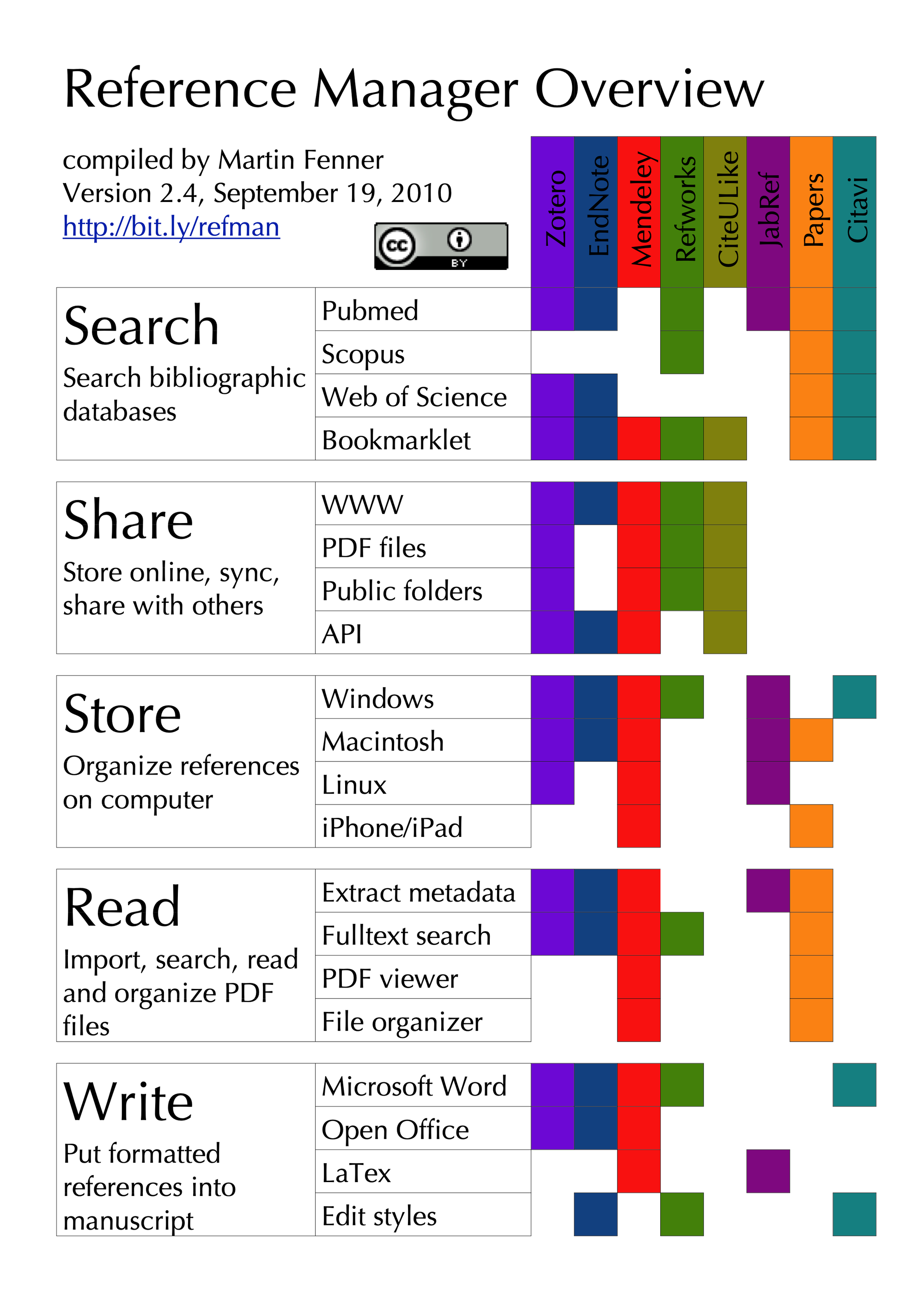
Comparing Zotero to other references helps to better understand what it does well and it what areas in can learn from other reference managers. I did this as early as 2009:
Zotero Storage is the optional add-on service to Zotero that provides online storage space for Zotero files. It is a solid service that has been around for close to 20 years, but it needs rethinking in times when we are increasingly worrying about Keeping information connected in a hostile information environment (Cameron Neylon keynote at PIDFest 2026). Because Zotero Storage is an optional add-on, Zotero will keep functioning when Zotero Storage would shut down or be blocked, in contrast to for example CiteULike, which ceased operations in 2019. But there is no technical reason to have only a single service for online Zotero storage, and in fact there have been numerous attempts to provide alternatives over the years.
Defter is not the first attempt to provide a Zotero sync server and file storage option, but it provides some unique features:
defter works in parallel to Zotero storage rather than as alternative.
Defter doesn't want to compete with Zotero Storage. Arching metadata and files in more places is the better archiving approach. Working in parallel provides a better user experience, and supports clients (e.g. iPads) that currently can't switch to alternative storage locations.
defter uses simple technology that can work for universities, small organizations, and research groups
Digital Sovereignty needs simple technical solution to be as widely available as possible. Defter is open source software with an MIT license installed as a single binary of less than 1 Mb that uses SQLite as database (as does Zotero). File attachments are stored in s3 object storage, the cheapest and most widely used network storage solution.
defter improves metadata of publications using DOIs
Defter uses commonmeta (built into the single binary) and SQLite to fetch and store DOI metadata for publications, and uses that to improve Zotero records. This supplements the DOI lookup integration built into Zotero, mainly by reducing the number of needed API calls, and by converting DOI metadata into the native Zotero format (CSL JSON).
defter syncs the publications in your ORCID record with Zotero My Publications
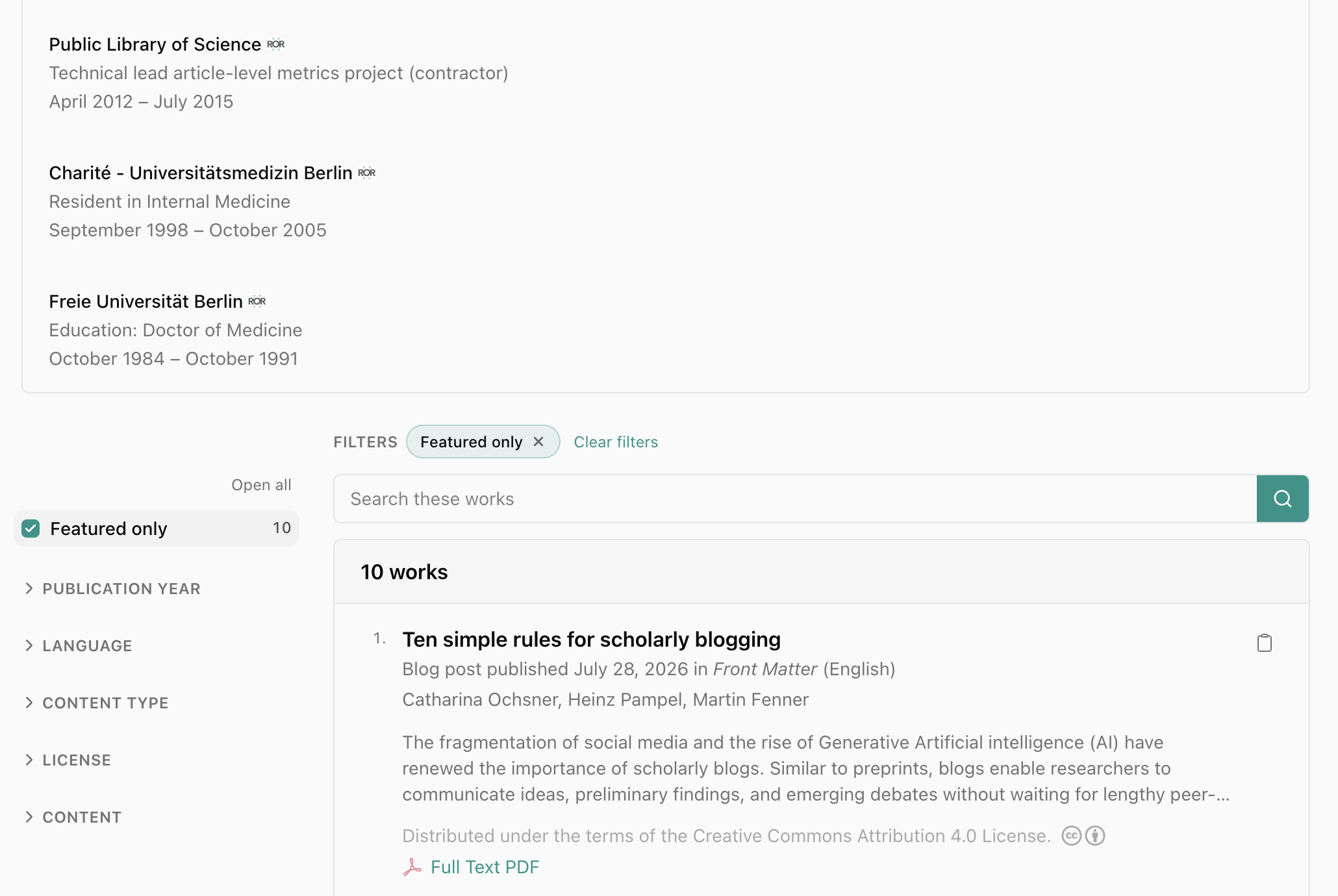
This feature automatically adds the publications from your ORCID record to Zotero. Until ORCID makes the featured works functionality available via API, Zotero users can highlight up to 10 featured works via tags.
defter provides a simple public profile page
defter is a server that can provide an optional public page with your publications, but also other information from your public ORCID profile (biography, web sites and social links, affiliations). This information is also available via API for integration in your personal or academic homepage (mine is here).
defter is currently in private beta as hosted service. Please reach out via Slack, email, Mastodon, or Bluesky if you want to join the beta or have questions about defter. You can of course also install the software for yourself and provide feedback via issues. I am particularly interested in academic institutions interested in running defter as a service for their staff and students.
The work on the Zotero API not only helps me to better understand the Zotero sync service, but also opens up another perspective: integrate Zotero reference management into blogging software, in particular static site generators such as Hugo, where you write posts on your local computer and have direct access to the Zotero local API.
References
- Fenner, M. (2009, March 4). Zotero: Interview with Trevor Owens. Front Matter. https://doi.org/10.53731/ftm7mbj-jpteh8h
- Fenner, M. (2014, October 17). Webinar on Writing Zotero Translators. Front Matter. https://doi.org/10.53731/r294649-6f79289-8cw02
- Fenner, M. (2009, March 15). Reference Manager Overview. Front Matter. https://doi.org/10.53731/r294649-6f79289-8cw42
- Neylon, C. (2026). Keeping information connected in a hostile information environment. https://doi.org/10.5281/ZENODO.23721279
- Fenner, M. (2026, October 26). Meet me at PIDFest in Leiden this week. Front Matter. https://doi.org/10.53731/k0rjt-qgs07