


Last Friday the next major version (v14.0.0) of the InvenioRDM repository software was released after many months of work involving lots of people (listed in the blog post). The changes and upgrade instructions are documented in detail the post on the Invenio blog. The most important change for the Rogue Scholar science blog archive, and the feature that I contributed, is the support added for Crossref DOI registration.
Rogue Scholar was running on v14.0.0 release candidate versions the past few months, so the upgrade to v14.0.0 was easy and happened on Friday. As part of the upgrade I changed the self-hosted web analytics service from Plausible Analytics to Hitkeep, mainly because its technology stack (Go, DuckDB) is a better fit for Rogue Scholar than Plausible’s (Elixir, Clickhouse, Postgres).
Please reach out to me if you need help with cloud hosting and/or commercial support, e.g. because you want to start an InvenioRDM repository with Crossref DOI registration for preprints, dissertations or other textual content.
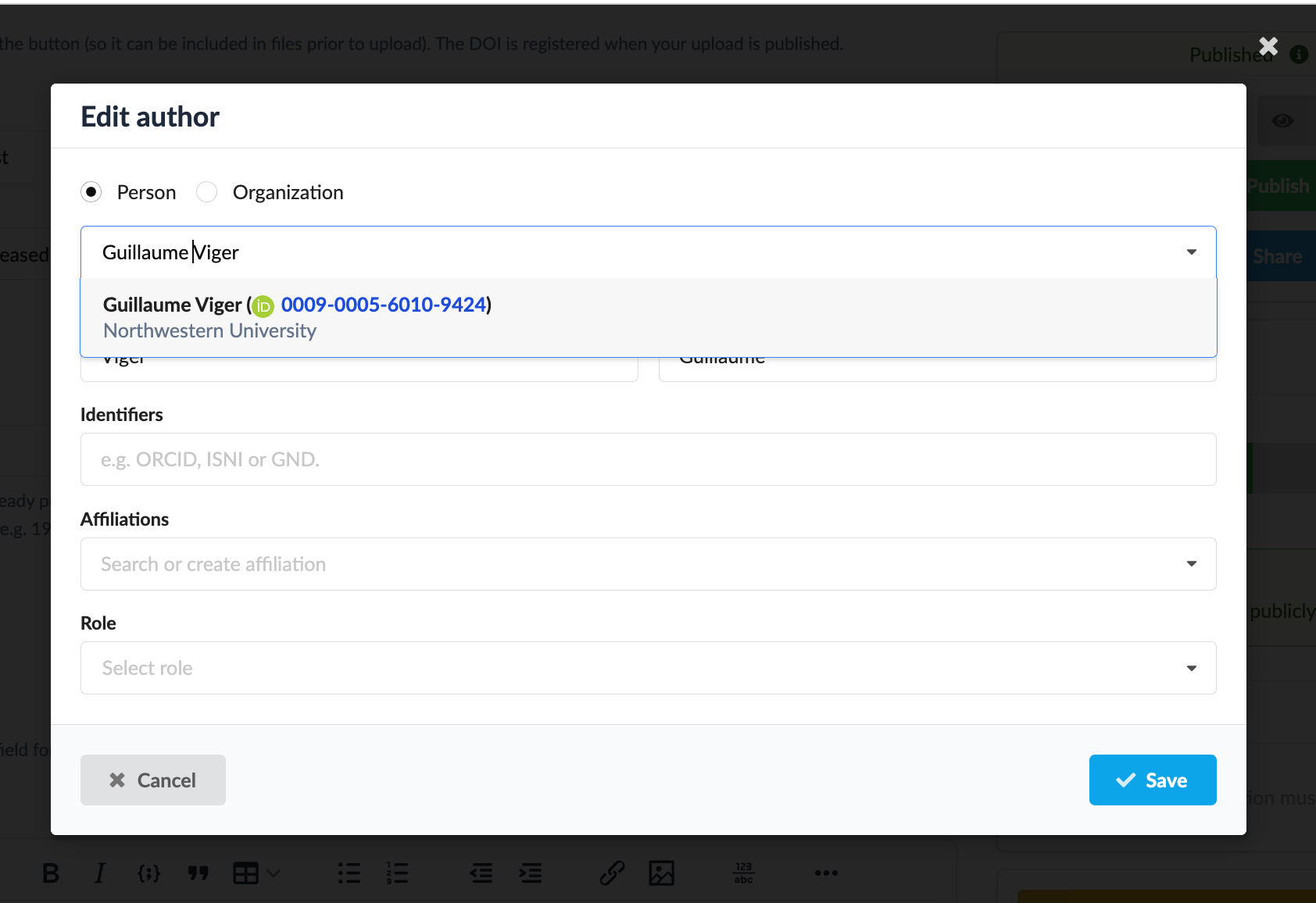
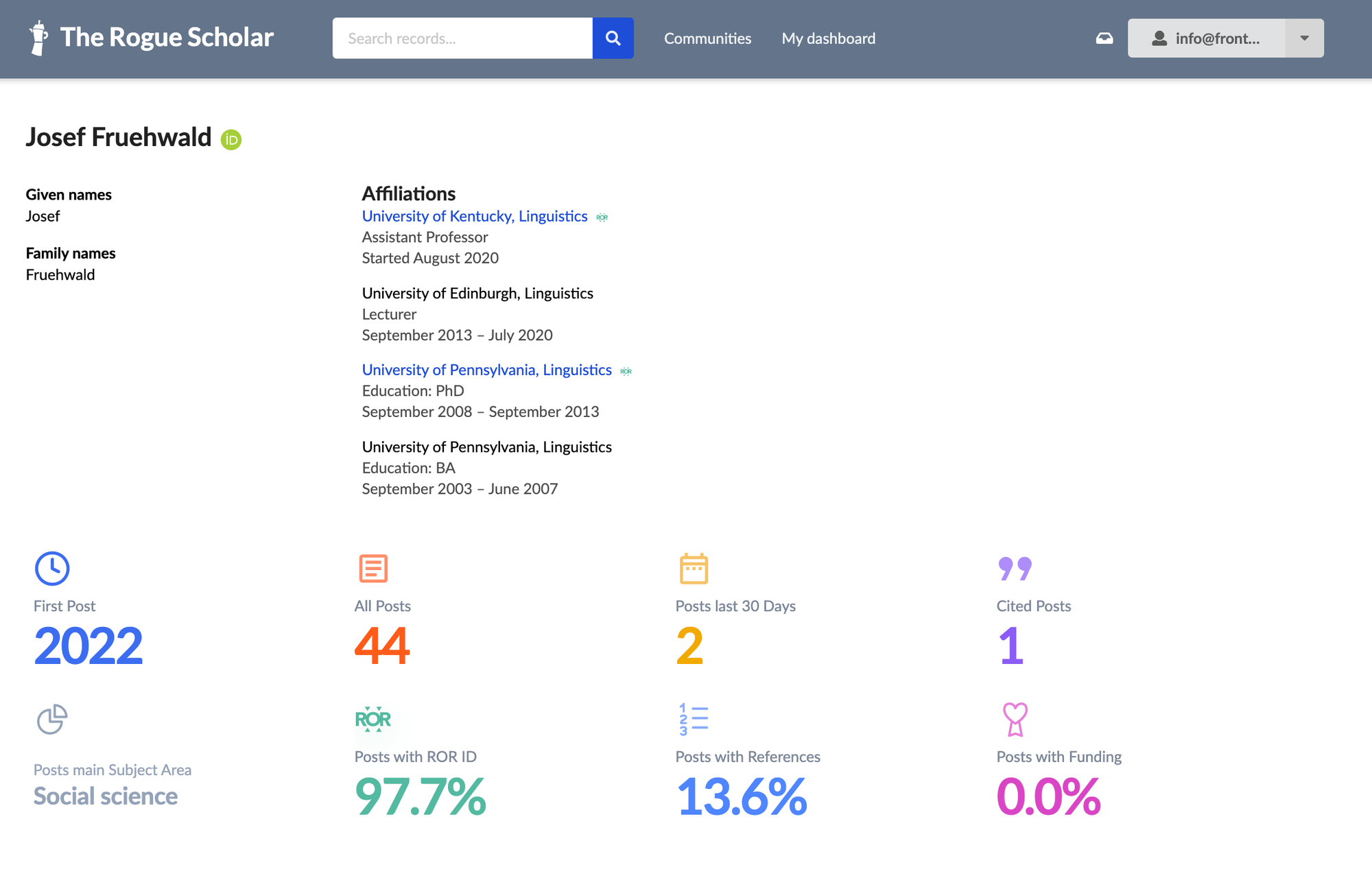
This week I released invenio-pidbox, an invenio module for InvenioRDM v14 that integrates a read-only sqlite database for content that is too large for InvenioRDM vocabularies (typically yaml or json format), in my case the ORCID Public Data File 2025 with 25 million records. The ORCID data in compressed XML format are converted into commonmeta JSON according to the new Commonmeta v1.0 schema, and integrated into InvenioRDM using commonmeta-py and the commonmeta-py extra commonmeta-rs with Rust bindings and sqlite support. This allows both ORCID metadata lookup as well as ORCID queries from within InvenioRDM.

For example in the records submission form:
Or the Rogue Scholar author profile:
Or the search for an author by name:
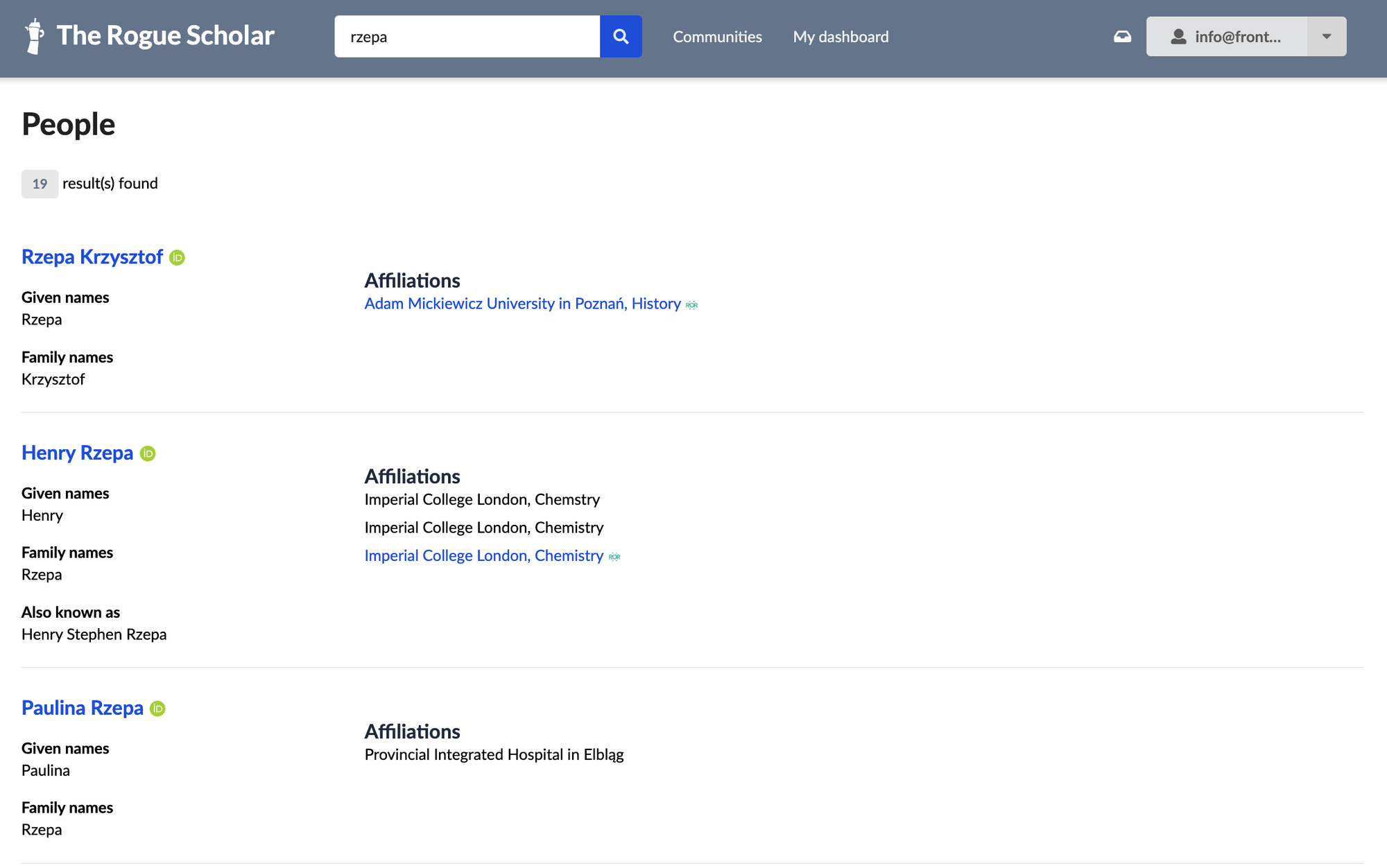
As I said before, ORCID metadata are used not only for author profiles, but also to handle names with multiple given or family names, and author affiliations – which need the work publication date and affiliation start and end dates.
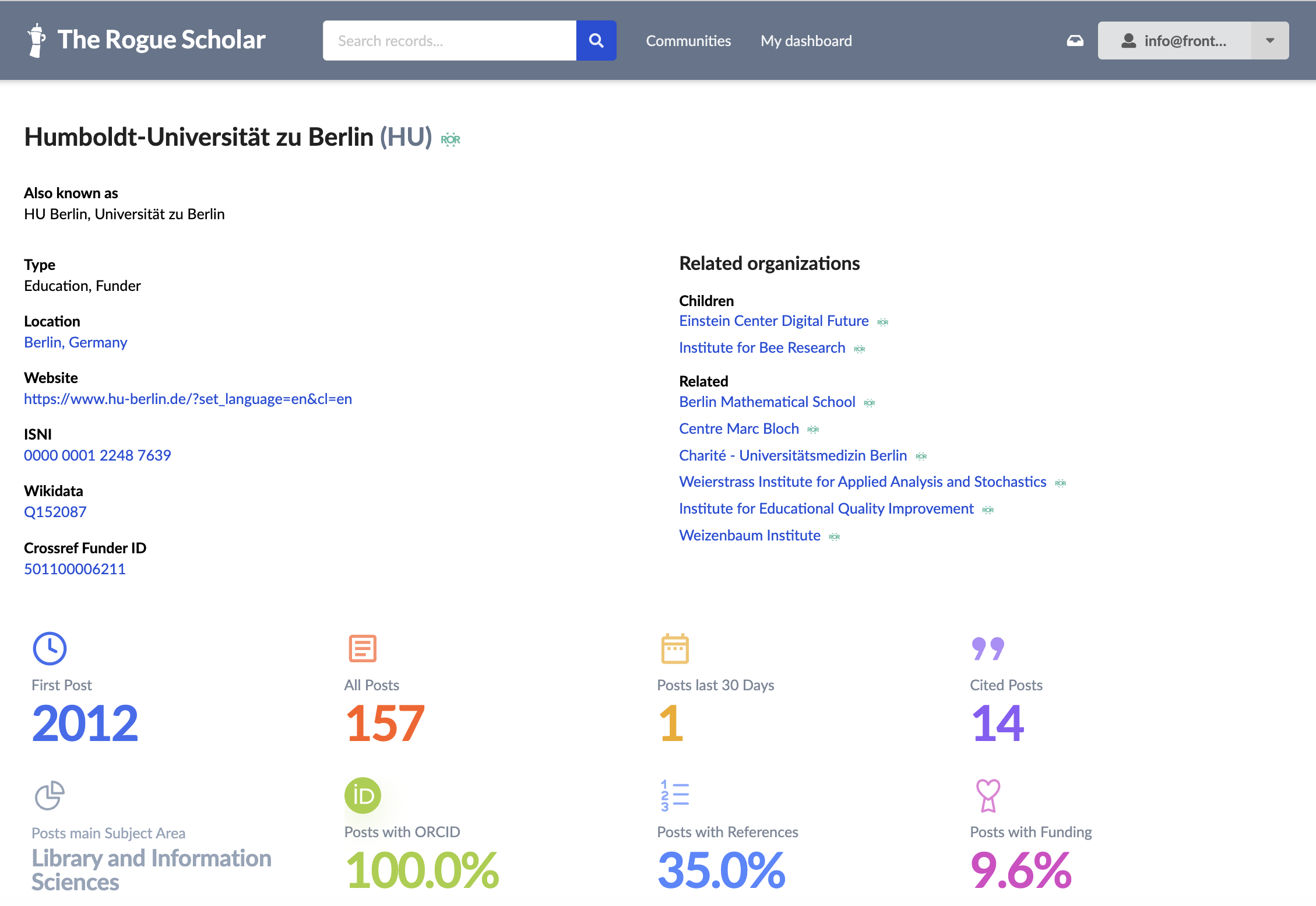
Affiliations are an important part of author information, and storing Research Organization Registry (ROR) metadata also in sqlite makes for an easier integration. InvenioRDM already supports automatic updates of ROR organization vocabularies, but only uses limited information. Invenio-pidbox knows all relevant information from ROR metadata and can show institution profiles, together with all publications from authors affiliated with that organization:
And allows search of an organization by name:
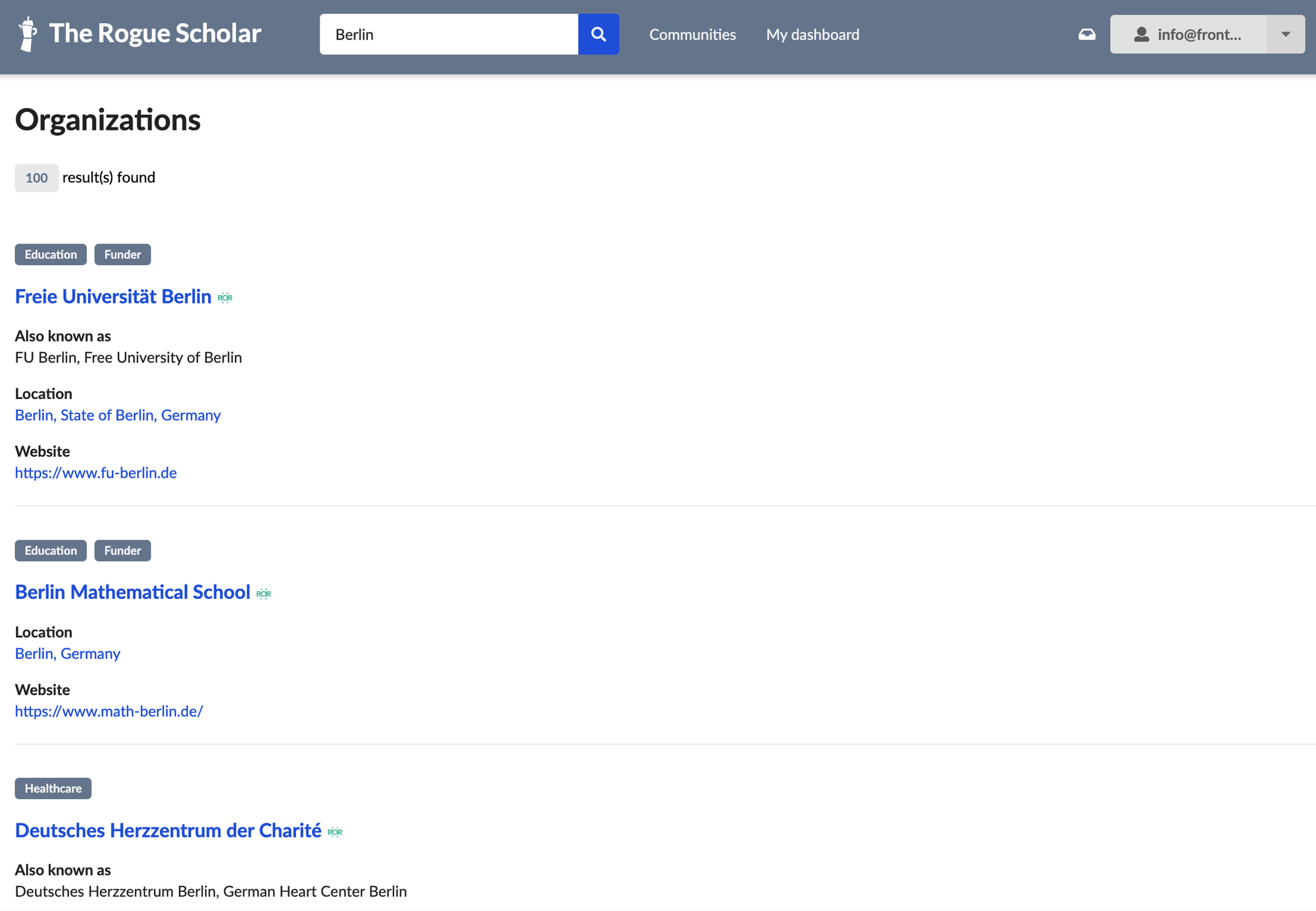
Institution profiles show basically the same information as the ROR website, plus all publications (in the case of Rogue Scholar blog posts).
The ROR API allows up to 2000 requests within a 5 min period, which is more than enough for most use cases. If you need to make more requests or want to ensure faster response times, ROR suggests to run the ROR API locally. With exactly the same data you can also run the ROR API via sqlite and the invenio-pidbox integration, and the same goes for the ORCID API (but requires more work as more data are frequently updated).
Putting all this into an invenio module instead of custom code in Rogue Scholar makes the functionality described above available to all InvenioRDM v14 instances, and I have for example installed the module with InvenioRDM Starter (demo website, documentation). InvenioRDM Starter facilitates deployment and configuration of InvenioRDM, allowing you to run InvenioRDM on your local computer within 15 min. This is achieved by providing
- a prebuilt Invenio-App-RDM Docker image.
- a Docker Compose configuration file with sensible defaults and searchable documentation.
Invenio-pidbox is used in production in Rogue Scholar but still early in development, in particular needs better documentation for configuring sqlite and importing annual data files. All ORCID and ROR records are a combined 90 GB, as I store the original metadata as well as the metadata converted into commonmeta format.
Please reach out via Slack, email, Mastodon, or Bluesky if you have any questions or comments.
References
- Viger, G. (2026, August 7). InvenioRDM v14.0 released. Invenio. https://doi.org/10.63517/kshzw-ay335
- ORCID. (2025). ORCID Public Data File 2025 (p. 237733993308 Bytes) [Dataset]. ORCID. https://doi.org/10.23640/07243.30375589
- Fenner, M. (2026, July 15). Announcing the commonmeta schema 1.0 release candidate. Front Matter. https://doi.org/10.53731/kdqkf-nf052
- Fenner, M. (2026, August 5). Rogue Scholar improves author profiles. Front Matter. https://doi.org/10.53731/ahkac-qfx88
- Research Organization Registry. (2026). ROR Data (Version v2.11) [Dataset]. Zenodo. https://doi.org/10.5281/ZENODO.6347574
- Fenner, M. (2024, June 17). Announcing InvenioRDM Starter Beta. Front Matter. https://doi.org/10.53731/jxecm-0me48