


Rogue Scholar uses the community functionality of the InvenioRDM repository platform to manage science blogs and their associated blog posts. In the community settings one can configure basic metadata such as blog name, description, logo and URL.
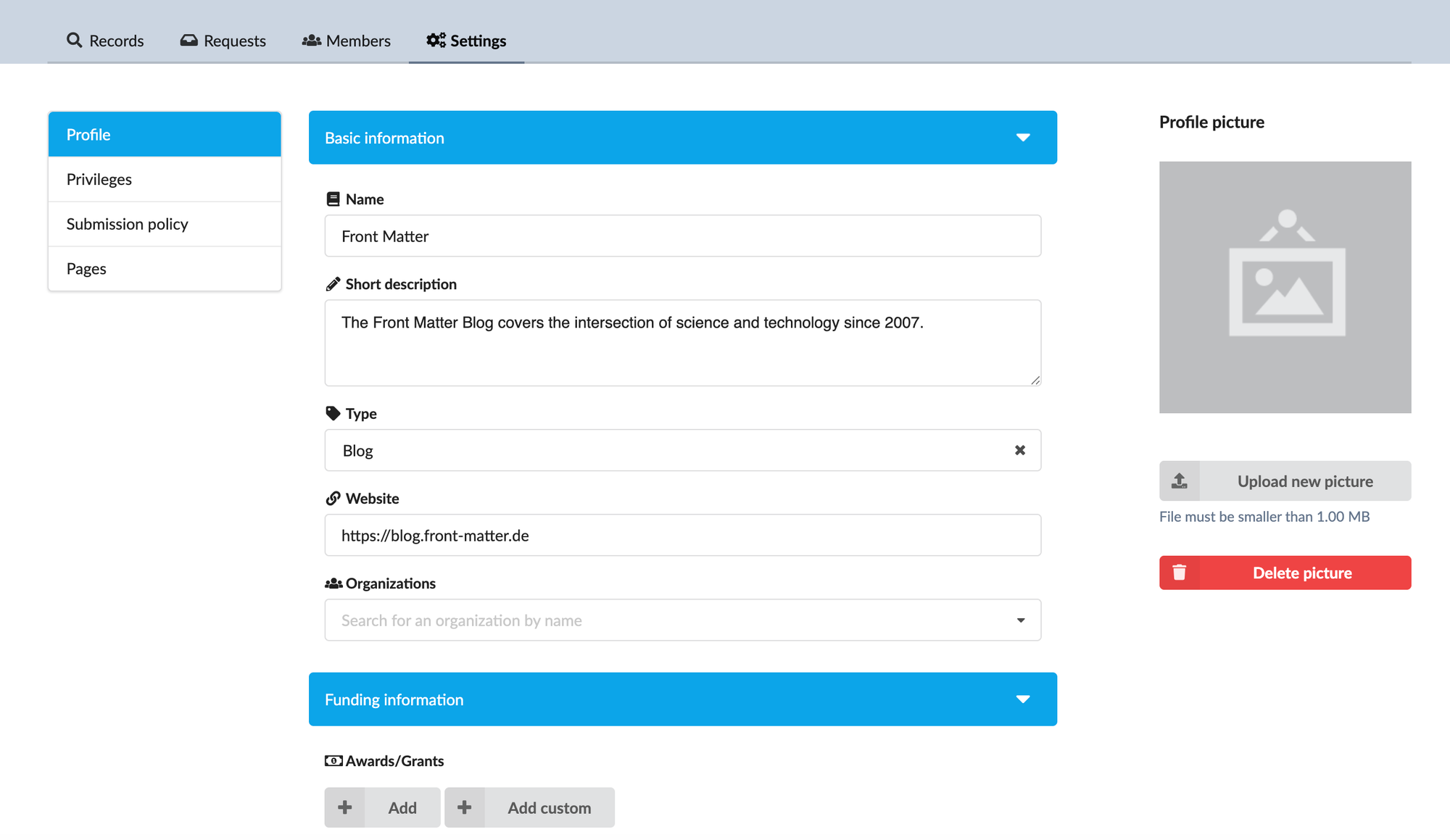
By default this information is automatically extracted from the blog feed (RSS, Atom or JSONFeed), and since July 2025 blog authors can change these settings directly in Rogue Scholar, e.g. because their blogging platform makes it difficult to add a logo or description.
Starting this week, more information can be updated: besides the required blog feed URL the optional ISSN and the main OpenAlex subfield of the blog. This is provided by community custom fields, and the subfield uses the OpenAlex subfield vocabulary built into Rogue Scholar and also used for blog post classification.
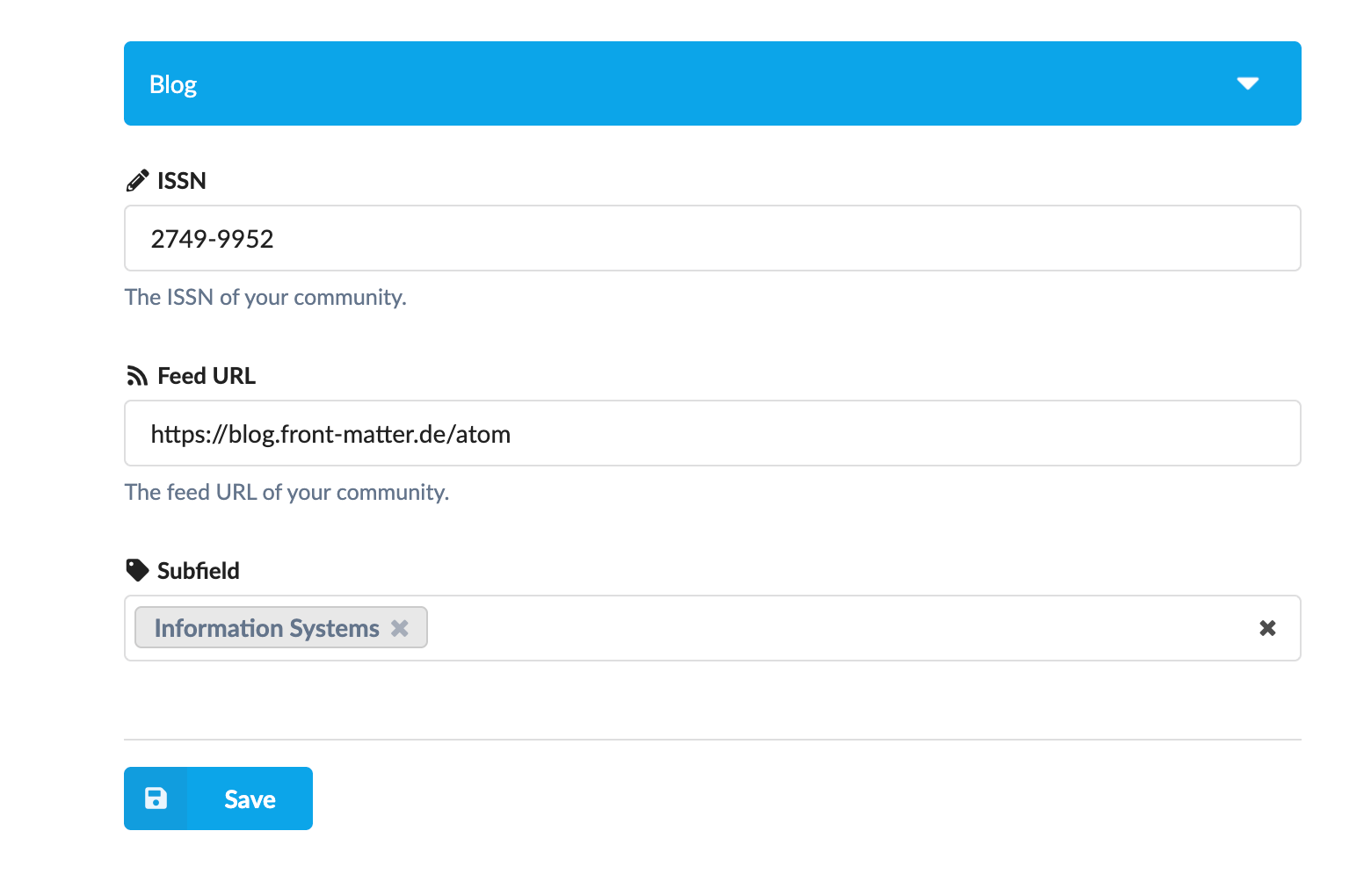
Some metadata still can't be changed by blog authors: the license (CC-BY) as it is fixed for all Rogue Scholar content, the Rogue Scholar join date, blog language, feed format (Atom, RSS or JSONFeed) and blogging platform (WordPress, Blogger, etc.) as they are determined automatically, and the DOI prefix, as this can't be as easily changed as other metadata.
InvenioRDM community members can have the roles reader, curator, manager and owner, and only owners have access to these settings. For a blog author to become an owner I have to send out an invitation to an existing Rogue Scholar account, which since the beginning of the year means an account managed by a self-hosted Keycloak instance.
This work integrates with another change to blog communities introduced last week, community dashboards:
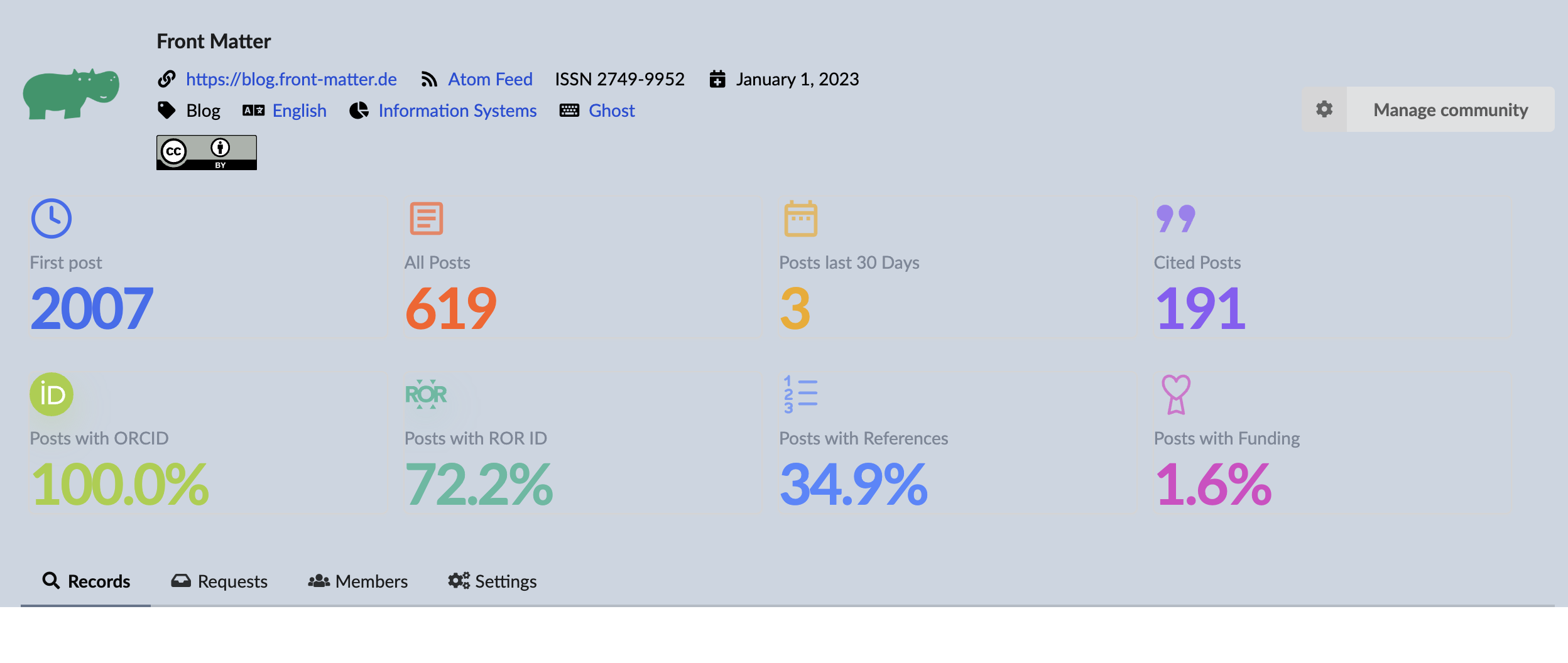
The dashboard shows the metadata from the community form, in the case of language, subfield and blogging platform now as a clickable link to all posts in Rogue Scholar with that blogging platform, etc.
What community owners still can't do is adding or updating blog posts as this is done automatically via their blog feed. And adding a new blog to Rogue Scholar still requires filling out a submission form (at the bottom of every Rogue Scholar page), as blog authors have to agree to provide the full-text in the blog feed with a CC-BY license, submissions are not automatically accepted, and minimal one-time setup work is required.
Please use Slack, email, Mastodon, or Bluesky if you are a blog author with Rogue Scholar and want to become the owner of your blog community, or have any questions or comments.
References
- Fenner, M. (2025, July 30). Rogue Scholar Updates: Full-text search as default and basic blog self-management. Front Matter. https://doi.org/10.53731/jeatk-t8t07
- Fenner, M. (2026, January 29). Rogue Scholar is improving subject classification (Version 3). Front Matter. https://doi.org/10.53731/76vm1-yme44
- Fenner, M. (2026, January 15). Rogue Scholar now supports passwordless authentication with magic links. Front Matter. https://doi.org/10.53731/tb8z7-7ft90
- Fenner, M. (2026, March 26). Introducing Rogue Scholar community dashboards. Front Matter. https://doi.org/10.53731/809xc-y7r79
